Engraved Medal with Ribbon: Custom Design & Buying Guide

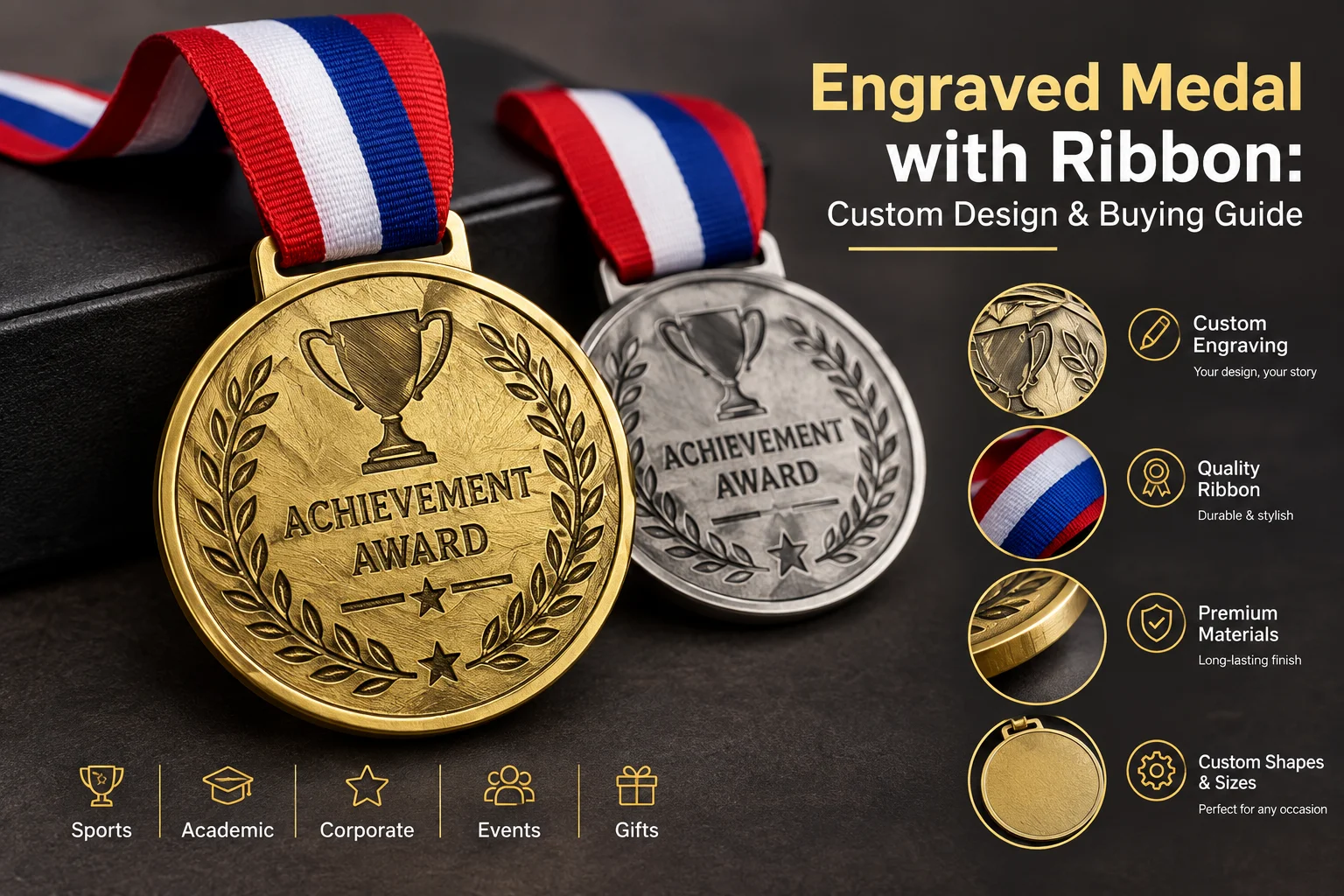
An engraved medal with ribbon is a meaningful way to recognize achievement, celebrate participation, and preserve special memories. Whether you are organizing a wrestling championship, school sports day, corporate awards ceremony, running competition, or community event, a personalized medal offers recipients a lasting reminder of their efforts.
Unlike a standard medal with a generic design, an engraved medal can feature a name, event title, date, achievement, logo, or short message. The ribbon adds another layer of customization, allowing you to match the medal to your event’s colors, branding, or theme.
However, choosing the right medal involves more than selecting an attractive design. You also need to consider the material, engraving method, medal size, ribbon quality, production requirements, and budget. These details affect the appearance, readability, durability, and overall value of the finished award.
This guide explains how engraved medals with ribbons work, which customization options are available, how to select suitable materials, and what to check before placing an order.
What Is an Engraved Medal with Ribbon?
An engraved medal with ribbon is an award featuring personalized lettering or artwork on its surface and a fabric ribbon attached through a loop or fitting. It is designed to recognize a specific achievement, event, individual, or group.
The medal usually serves as the main visual feature, while the ribbon makes it easy to wear around the neck or display with other awards.
Depending on the manufacturer and design, the medal may include engraved text, raised lettering, recessed details, printed artwork, colored enamel, or a combination of these features.
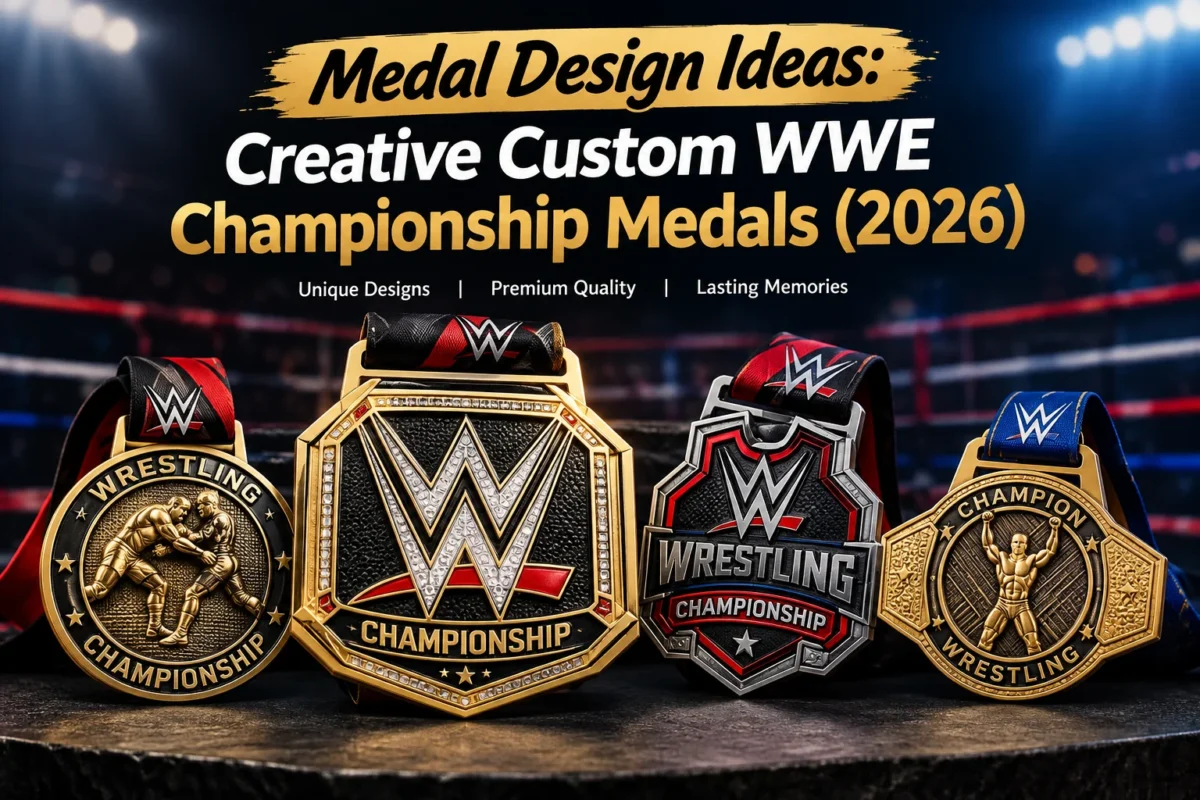
For example, a wrestling tournament medal might display the competition name on the front, the recipient’s placement on the reverse, and a ribbon in the event’s signature colors. A school award might feature a student achievement, graduation year, or school emblem.
Common Uses for Engraved Medals
Engraved medals are suitable for a wide range of occasions, including:
- Sports competitions: Recognize winners, runners-up, finalists, and participants in wrestling, football, cricket, athletics, swimming, and other sports.
- School and college events: Celebrate academic excellence, attendance, student leadership, and extracurricular achievements.
- Corporate recognition: Reward employees for performance, service milestones, teamwork, or professional accomplishments.
- Community events: Commemorate charity walks, local tournaments, cultural celebrations, and volunteer contributions.
- Military-inspired and commemorative events: Create personalized keepsakes for ceremonies, reunions, and special occasions, using appropriate designs.
- Personal celebrations: Mark anniversaries, family competitions, club achievements, or memorable milestones.
The best design depends on the reason for presenting the medal. A competitive sporting award may require clear placement details, while a commemorative medal may focus on a date, name, or meaningful message.
Why Choose a Custom Engraved Medal with Ribbon?
A customized medal can communicate the importance of an achievement more effectively than a generic award. It gives the organizer control over the message, visual identity, and presentation.
Here are some important advantages to consider.
1. Personalization Makes the Award Meaningful
Personalized engraving connects the medal directly to the event or recipient. Adding a competition name, year, category, or achievement makes the award more distinctive.
For example, a medal engraved with “Wrestling Champion 2026” has a clear purpose and commemorates a particular accomplishment. Similarly, a medal featuring a school name and graduation year can become a keepsake that recipients retain long after the ceremony.
For individual awards, names can add a personal touch. For larger events, engraving a shared event title and achievement category may be more practical.
Before choosing personalized details, decide whether every medal will have identical wording or whether individual names and positions must vary.
2. Ribbons Improve Presentation
The ribbon is an important part of the overall design. Its color, width, material, and attachment method influence how the medal looks when worn.
A red ribbon might suit a championship event, while blue, green, black, or multicolored ribbons may better reflect a club, school, organization, or competition theme.
You can also consider custom-printed ribbons featuring an event name, organization logo, or repeated text pattern, depending on the supplier’s capabilities.
For awards presented to large groups, using consistent ribbon colors helps create a coordinated appearance across the ceremony.
3. Suitable for Different Budgets
Custom medals are available in different materials, sizes, finishes, and production methods. This makes it possible to select an option that fits your available budget without automatically sacrificing the quality of the design.
A simple metal medal with clear engraving and a standard ribbon may be suitable for a school activity or participation award. A larger medal with detailed artwork, a premium finish, and a custom-printed ribbon may be more appropriate for a major championship.
The important point is to prioritize the features that matter most to your event instead of paying for unnecessary decorative elements.
4. Creates a Lasting Reminder
A medal is a physical reminder of an experience. Recipients may display it in a collection, place it in a frame, or keep it with other personal achievements.
Adding a date, event title, or relevant inscription helps preserve the context of the award. This is especially useful for annual tournaments and recurring competitions, where medals from different years can become part of a longer record of achievement.
Types of Engraved Medals with Ribbons
There is no single medal style that works for every event. The right choice depends on the design, quantity, intended use, and level of customization required.
1. Custom Metal Engraved Medals
Metal medals are a common option for competitions and formal recognition. They can offer a solid appearance and support a variety of shapes, finishes, and lettering styles.
Depending on the manufacturing process, the medal may feature a flat engraved surface, raised elements, recessed lettering, or a textured background.
Metal options can include zinc alloy, brass, iron, and other suitable alloys. Their weight, detail, finish, and cost vary, so ask the manufacturer which material is used for the specific product.
These medals work well for sports championships, wrestling events, school awards, and corporate recognition.
2. Gold, Silver, and Bronze Medals
Gold-tone, silver-tone, and bronze-tone medals are traditionally associated with first, second, and third place.
This color system is familiar to many participants and makes it easy to distinguish competition results at a glance.
However, a gold-tone medal is not necessarily made from solid gold, and a silver-tone medal is not necessarily made from solid silver. Many affordable awards use a base metal with a decorative plated or colored finish.
If material composition matters to you, confirm the actual metal and finish with the supplier before ordering.
You can also personalize each medal with the event name, year, competition category, or placement.
3. Die-Struck and Die-Cast Medals
Die-struck and die-cast medals are produced through different manufacturing processes, which influence their appearance and the details they can accommodate.
Die-struck medals are formed by pressing a design into metal, creating raised and recessed areas. They can work well for lettering, borders, symbols, and relatively clear graphic designs.
Die-cast medals are made by pouring or injecting molten material into a mold. Depending on the design and manufacturing process, this method can accommodate more dimensional shapes and complex contours.
Neither method is automatically the best choice for every project. The ideal option depends on the artwork, required detail, quantity, budget, and manufacturer’s capabilities.
If your design contains small text or intricate logos, request a production preview to confirm that the details will remain clear at the chosen medal size.
4. Custom-Shaped Medals
A medal does not have to be round. Custom shapes can help connect the award to a specific sport, organization, or event.
Examples include:
- Wrestling championship shields
- Star-shaped achievement medals
- Sports equipment silhouettes
- School or club emblem shapes
- Event-specific geometric designs
- Custom outlines based on an approved logo
Unique shapes can make an award more recognizable, but they should remain practical to manufacture and wear. Extremely narrow projections, sharp edges, and overly complicated outlines may increase production difficulty.
Ask the manufacturer to review your design and recommend suitable dimensions before approving the final shape.
5. Printed or Enamel-Color Medals
If your design depends on multiple colors, consider a medal with printed artwork or colored enamel.
These techniques can help reproduce team colors, event logos, flags, symbols, and other visual elements. Their appearance and durability depend on the material, application method, finish, and production quality.
For instance, a wrestling tournament medal could combine a metallic border with colored enamel in the center and engraved lettering around the edge.
Choose a design in which the text remains readable and the colors complement rather than overwhelm the medal’s main details.
How to Choose the Right Material for an Engraved Medal
The material affects the medal’s weight, appearance, durability, production method, and cost. Understanding the available options helps you choose an award that fits its purpose.
Zinc Alloy
Zinc alloy is used in many custom medals because it can support detailed shapes and dimensional designs. It may be suitable for awards featuring logos, decorative borders, recessed areas, and raised lettering.
The finished appearance depends on the alloy composition, manufacturing process, surface preparation, and coating.
Zinc alloy is worth considering when you want a custom design with noticeable depth without necessarily choosing a premium precious metal.
Brass
Brass is another option for metal awards. It can support engraving and different surface finishes, depending on the manufacturing process.
It may suit formal recognition medals, commemorative pieces, and designs that benefit from a traditional metallic appearance.
Ask about the brass grade, thickness, surface finish, and engraving method rather than relying on the material name alone to judge quality.
Iron and Other Metal Options
Iron and other metal materials may be used for particular medal designs, depending on the supplier and production requirements.
When comparing options, consider the medal’s weight, resistance to corrosion, edge quality, and suitability for the intended finish.
A material that works well for a simple participation medal may not be ideal for a detailed custom design. Request a sample or clear photographs of comparable finished products whenever possible.
Plastic and Lightweight Materials
Plastic and other lightweight materials can be suitable for casual activities, children’s events, costume competitions, and occasions where affordability or low weight is a priority.
These options can be produced in various colors and shapes, although their appearance and engraving capabilities differ from those of metal medals.
If you want the traditional look of a metal award, check whether a lightweight alternative provides the finish you expect.
Which Material Should You Select?
Start with three questions:
- Will recipients wear the medal, display it, or use it mainly as a commemorative item?
- Does the design require fine engraving, raised details, multiple colors, or a complex shape?
- What budget is available for each medal, including its ribbon and any personalization?
Answering these questions will help narrow your choices before you compare suppliers.
Remember that material alone does not determine quality. Construction, thickness, finishing, engraving clarity, and ribbon attachment also contribute to the final result.
The next step is to choose the right engraving style and prepare the design details that will make your medal distinctive.
Engraving Options, Ribbon Styles, Customization, and Buying Tips
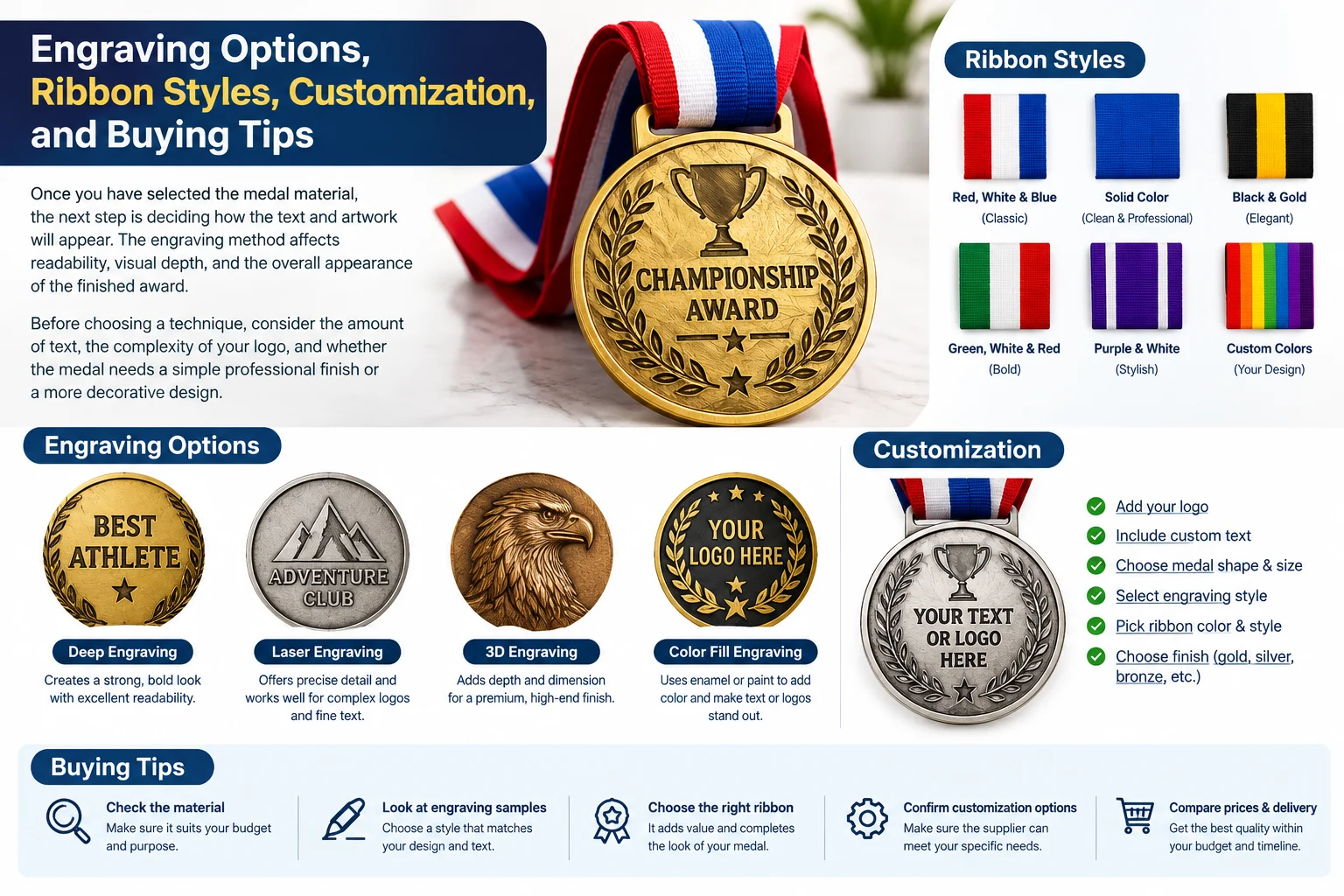
Once you have selected the medal material, the next step is deciding how the text and artwork will appear. The engraving method affects readability, visual depth, and the overall appearance of the finished award.
Before choosing a technique, consider the amount of text, the complexity of your logo, and whether the medal needs a simple professional finish or a more decorative design.
1. Laser Engraving
Laser engraving uses a focused laser to mark a surface. Depending on the material and finish, it can create precise lettering, numbers, dates, and relatively detailed graphics.
This method may be suitable for personalized medals featuring individual names, competition results, or short inscriptions.
For example, a school might order medals with the same front design but different student names on the reverse. Laser marking can be useful for this type of personalization when the chosen material supports the process.
However, laser engraving does not produce the same appearance on every metal. The contrast and visibility depend on the surface coating, material, and equipment used.
Always request a sample or production preview if the engraving must be especially clear.
2. Traditional Metal Engraving
Traditional engraving involves cutting or removing material from the surface to create lettering, symbols, or decorative details.
It can produce a refined appearance and may be appropriate for commemorative awards, formal recognition, and personalized keepsakes.
The final result depends on the metal, engraving depth, lettering style, and available space.
If your medal includes several lines of text, keep the wording concise. Too much information can make the design crowded and difficult to read.
3. Raised and Recessed Lettering
Some custom medals feature raised lettering, recessed backgrounds, or a combination of both.
Raised elements stand out from the surrounding surface, while recessed details sit below it. These effects can add dimension to logos, borders, event names, and decorative patterns.
For example, a wrestling championship medal could feature a raised championship emblem surrounded by recessed lettering and a textured background.
This approach is particularly useful when you want the medal to look more detailed than a flat printed design.
4. Printed Artwork and Color Finishes
Not every design needs to rely entirely on engraving. Printing, enamel coloring, and decorative finishes can introduce color and visual contrast.
A medal might combine engraved text with a printed event logo or colored enamel details. This allows you to preserve important wording while incorporating the visual identity of a school, sports club, or organization.
Before approving a multicolored design, check the spelling, logo proportions, color placement, and contrast between the artwork and background.
How to Customize an Engraved Medal with Ribbon
Customization allows you to create a medal that reflects the purpose and identity of your event. The most effective designs balance personalization with readability.
Here are the main elements to consider.
1. Choose the Medal Shape and Size
Round medals are versatile and familiar, but shields, stars, squares, and custom silhouettes can provide a distinctive appearance.
The appropriate size depends on the design and the way the medal will be presented. A larger medal provides more room for detailed artwork and text, but it may also weigh more and require a wider ribbon.
A smaller medal can be practical for children, participation awards, and events involving large numbers of recipients.
Before confirming the dimensions, check the available space for the main logo, inscription, and border. Make sure that important text will remain readable at the actual production size.
2. Add a Logo or Event Name
A logo or event name helps identify the organization behind the award.
For a wrestling tournament, the front might feature the event title and a wrestling-inspired emblem. The reverse could include the competition date, venue, or achievement category.
Schools and corporate organizations can use their own approved logos to maintain consistent branding.
If you are supplying artwork, ask the manufacturer which file formats and image resolutions are accepted. Vector artwork is often useful for scalable logos, although the supplier’s specific requirements should guide your preparation.
Avoid using too many logos or decorative elements. One clear focal point usually creates a stronger design than several competing features.
3. Personalize Names, Dates, and Achievements
Text personalization is one of the most useful features of an engraved medal.
Depending on the purpose, you might include:
- Recipient’s name
- Event or tournament title
- First-, second-, or third-place placement
- Competition year
- School, club, or organization name
- A short message of recognition
For example, a medal could read:
Front: Annual Wrestling Championship 2026
Reverse: First Place — Under-18 Division
This layout identifies both the event and the achievement without overcrowding the medal.
For individual names, confirm whether the supplier can personalize every medal separately. Some orders require a spreadsheet containing the exact spelling and corresponding award category.
Proofread the entire list before approving production. Correcting an error before manufacturing is generally easier than resolving it after the medals have been completed.
4. Select a Suitable Finish
The finish influences how the medal looks under different lighting conditions and how well its details stand out.
Common options include:
- Gold-tone finish for a traditional first-place award
- Silver-tone finish for second-place recognition
- Bronze-tone finish for third-place awards
- Antique-style finishes for a textured, traditional appearance
- Polished finishes for a brighter metallic look
- Matte finishes for a more understated appearance
Availability depends on the medal material and manufacturer.
When choosing a finish, consider the artwork’s contrast. Fine lettering may be easier to read when the background and text have visibly different tones or textures.
Choosing the Right Ribbon for Your Medal
The ribbon is more than an attachment. It affects the medal’s presentation, comfort, and suitability for the event.
A well-matched ribbon makes the complete award look coordinated, particularly when several medals are presented together.
1. Ribbon Colors
Ribbon colors can distinguish award categories, represent an organization, or complement the medal’s finish.
For example, a tournament might use different ribbon colors for championship, runner-up, and participation awards. A school may instead use its official colors across every medal.
There is no universal color system that every event must follow. Choose a scheme that makes sense for your competition and communicate it clearly to the manufacturer.
If multiple colors are used, prepare a simple list identifying which ribbon belongs to each medal type.
2. Custom-Printed Ribbons
Custom-printed ribbons can feature an event name, logo, sponsor name, or short message.
They are especially useful when the ribbon itself needs to reinforce the event’s identity. A marathon, school tournament, charity competition, or annual championship can use the same design across its medals for a consistent appearance.
Keep the ribbon text short enough to remain readable. Long inscriptions may become difficult to understand when printed on a narrow strip of fabric.
Ask the supplier about printing methods, available ribbon widths, color limitations, and minimum order quantities before finalizing the design.
3. Ribbon Material and Width
Ribbon material affects its texture, flexibility, appearance, and durability.
Common options include polyester and other woven or synthetic fabrics. The best choice depends on the supplier’s available products and the level of finish you want.
A wider ribbon can provide more space for printed artwork and may complement a larger medal. A narrower ribbon may suit lightweight awards or smaller designs.
Also check the attachment point. The medal should hang securely without excessive movement, sharp edges, or a fitting that damages the ribbon.
If recipients will wear the medals for extended periods, consider ribbon comfort and the overall weight of the award.
4. Standard vs. Custom Ribbons
A standard ribbon is often a practical choice when you need an affordable, straightforward award. It can be suitable for school activities, local competitions, and events where the medal itself carries most of the design.
A custom ribbon is worth considering when branding, event identity, or presentation is particularly important.
Compare the total cost of both options rather than looking only at the ribbon price. Custom printing, additional colors, special widths, and setup requirements may affect the final quotation.
How to Order an Engraved Medal with Ribbon
Ordering becomes easier when you prepare the essential information before contacting a supplier.
Follow these steps to reduce confusion, avoid preventable mistakes, and make sure the finished medals meet your expectations.
Step 1: Define the Purpose of the Medals
Start by identifying the event and the people receiving the awards.
Are the medals for a wrestling championship, school sports day, employee recognition program, or community competition?
The purpose influences the design, material, size, inscription, and budget.
If the awards will be distributed across different age groups, consider whether the same medal design is suitable for everyone or whether separate versions are needed.
Step 2: Confirm the Quantity and Budget
Determine how many medals you need and whether the order includes different award categories.
For example, a tournament might require separate medals for winners, runners-up, and participants. It may also need different inscriptions for age groups or competition divisions.
Prepare a quantity breakdown before requesting a quotation.
Ask whether the price includes the ribbon, engraving, logo setup, packaging, and any other customization charges. Also confirm shipping costs and whether taxes or other fees apply.
This helps you compare quotations on a like-for-like basis.
Step 3: Prepare the Artwork and Text
Collect the approved logo, event name, recipient details, and any other required information.
Keep the text organized and identify which details belong on the front, reverse, and ribbon.
For larger orders, a spreadsheet can help organize names, categories, and inscription variations. Use consistent spelling and clearly label each version.
If you do not have finished artwork, ask whether the supplier can help prepare a design from your ideas or existing logo.
Step 4: Request a Digital Proof
Before production begins, request a digital proof or design preview whenever available.
Review the following details carefully:
- Correct spelling of names and event titles
- Logo accuracy and proportions
- Medal dimensions and shape
- Text size and placement
- Front and reverse designs
- Metal finish and color choices
- Ribbon color, width, and printed details
- Attachment method and overall appearance
A design that looks attractive on a computer screen may need adjustments when scaled to a small medal.
Do not approve the design until all important details are correct.
Step 5: Confirm Production and Delivery
Ask the supplier to provide an estimated production timeline and shipping schedule.
Custom orders may require artwork approval, manufacturing, engraving, finishing, assembly, and packaging. The time required varies according to order size, design complexity, material availability, and the supplier’s workload.
If your medals are needed for a scheduled ceremony, communicate the event date before confirming the order.
Allow a reasonable buffer for shipping delays and unexpected production changes. If delivery timing is essential, request written confirmation of the expected dispatch and arrival dates.
Step 6: Inspect the Finished Order
When the medals arrive, check them against the approved proof and order details.
Look for spelling errors, missing items, damaged ribbons, uneven finishes, loose fittings, and noticeable differences between the supplied products and the approved design.
For large orders, count the medals and verify that the correct inscriptions and award categories have been supplied.
Contact the supplier promptly if you identify a problem, providing photographs and a clear description of the issue.
How Much Does an Engraved Medal with Ribbon Cost?
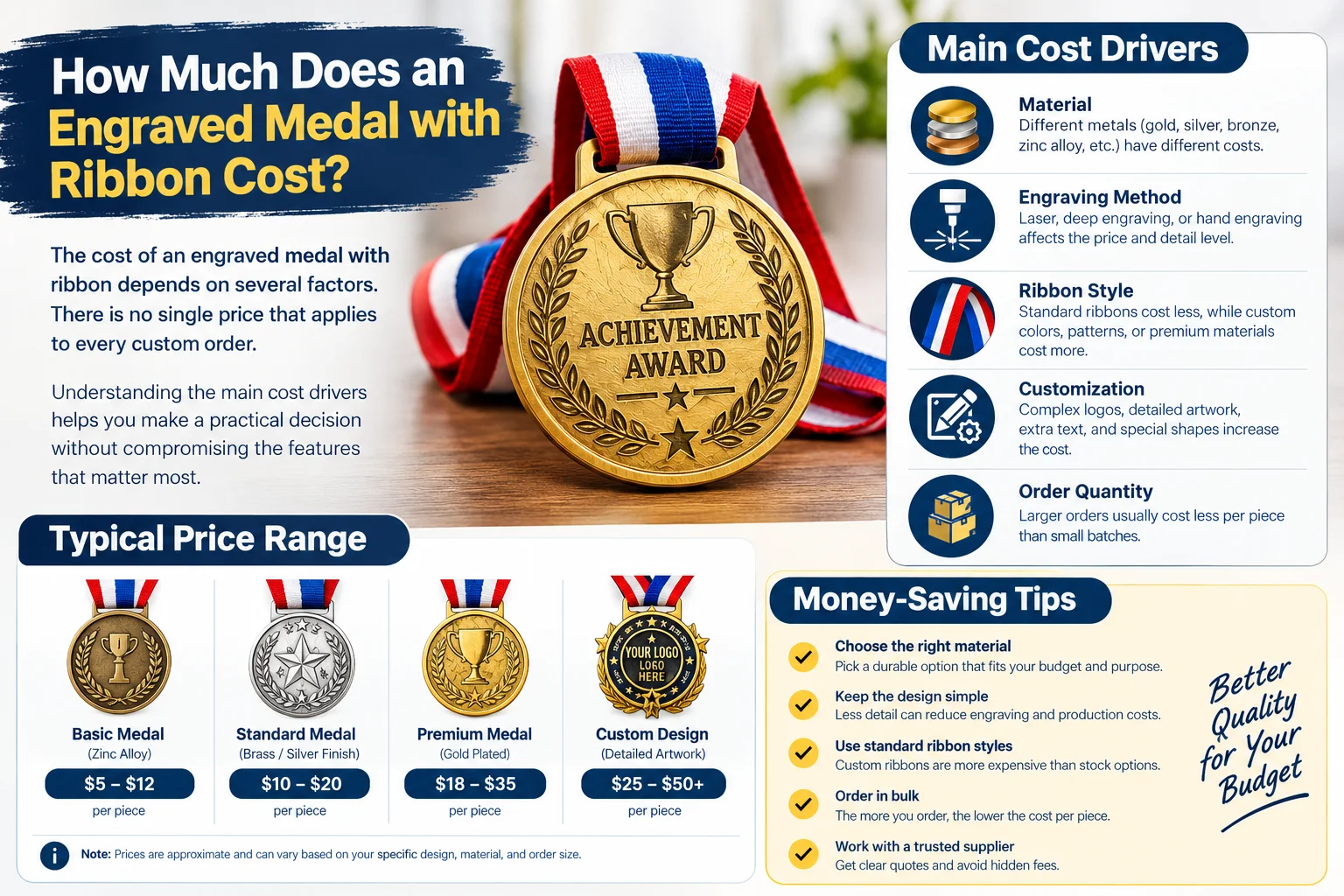
The cost of an engraved medal with ribbon depends on several factors. There is no single price that applies to every custom order.
Understanding the main cost drivers helps you make a practical decision without compromising the features that matter most.
Factors That Influence the Price
Material: Different metals and lightweight alternatives have different production costs.
Size and thickness: Larger or thicker medals may require more material and additional manufacturing work.
Engraving complexity: Simple lettering may be less expensive than detailed artwork, multiple personalized inscriptions, or specialized finishing.
Ribbon customization: Standard ribbons may cost less than custom-printed versions requiring additional artwork or production setup.
Order quantity: Some suppliers offer different per-unit pricing according to quantity, while others have minimum order requirements or setup charges.
Packaging: Individual boxes, protective pouches, and presentation packaging may increase the total cost.
Shipping: Delivery location, package weight, shipping method, and order size can affect the final amount.
How to Get Better Value
The most effective way to manage your budget is to prioritize the features that matter to your recipients.
If your event needs a large quantity of participation medals, a straightforward metal design with a standard ribbon may be sufficient. For a major championship, you might allocate more of the budget to distinctive artwork, a more substantial medal, or custom-printed ribbons.
Request quotations from suppliers using the same specifications. Compare material, dimensions, engraving, ribbon, packaging, delivery, and revision policies rather than choosing solely on the lowest advertised price.
How to Choose a Reliable Custom Medal Supplier
A good supplier should understand your requirements, explain available options, and communicate clearly throughout the ordering process.
Before placing an order, consider these points.
Review Previous Work
Look for photographs of completed medals similar to the style you want.
Check the clarity of the engraving, consistency of the finish, quality of the ribbon attachment, and overall workmanship.
If the supplier has experience producing sports awards or custom championship medals, ask to see relevant examples rather than relying only on unrelated product photographs.
Check Customization Capabilities
Confirm that the supplier can provide the exact features you need, including personalized text, logo engraving, custom shapes, colored finishes, or printed ribbons.
Not every manufacturer offers every technique. A clear discussion at the beginning can prevent misunderstandings later.
Understand the Order Terms
Ask about minimum quantities, production times, artwork revisions, payment terms, shipping, and the process for reporting defects.
For a large or time-sensitive order, written confirmation is particularly helpful.
Do not assume that engraving, shipping, or premium packaging is included in the advertised price. Request a complete quotation.
Evaluate Communication
A reliable supplier should answer reasonable questions and explain any limitations that affect your design.
They should also identify details that need clarification before production, such as missing artwork, unclear text, or unsuitable dimensions.
Clear communication is especially important when every medal contains different names or achievements.
Creative Engraved Medal with Ribbon Ideas
If you are still deciding on a design, consider these practical ideas for different occasions.
Wrestling and Sports Championships
Create a medal featuring the tournament name, sport-specific artwork, and the competition year. Add the placement or division on the reverse and coordinate the ribbon with the event’s branding.
For a championship series, maintaining a consistent design across multiple years can help create a recognizable collection.
School Achievement Awards
Use the school emblem, student achievement, and academic year. Different inscriptions can recognize academic performance, teamwork, participation, or extracurricular accomplishments.
Choose readable text and an appropriate size for the recipients.
Corporate Recognition
A company logo and concise inscription can mark an employee milestone, team achievement, or service anniversary.
A restrained metallic finish and coordinated ribbon may suit formal workplace events better than an overly elaborate design.
Charity Runs and Community Events
Feature the event name, date, and a simple symbol connected to its purpose.
For recurring fundraisers or annual community activities, a series of related designs can make each year’s medal distinct while maintaining a consistent identity.
Personalized Gifts and Keepsakes
Create a medal featuring a meaningful date, name, short message, or custom symbol.
These designs can commemorate family competitions, club milestones, personal accomplishments, and special celebrations.
Before finalizing the inscription, make sure it communicates the intended message without filling every available space.
Frequently Asked Questions About Engraved Medals with Ribbons
Can I put a name on an engraved medal with ribbon?
Yes, many suppliers offer name personalization. Depending on the product, names can be engraved on the front or reverse. For multiple recipients, confirm that individual inscriptions are available and provide an accurate list before production.
Can I customize both the medal and ribbon?
Many custom medal suppliers offer several combinations of medal artwork, finishes, ribbon colors, and printed ribbon designs. Available options vary by manufacturer, so confirm the choices, minimum quantities, and additional costs before ordering.
Which medal material is best for engraving?
The best material depends on your design, budget, and intended use. Zinc alloy, brass, and other metals may support different engraving and finishing methods. Ask the manufacturer which material and technique will produce the clearest result for your artwork.
How long does it take to make custom engraved medals?
Production time varies with order quantity, design complexity, personalization requirements, material availability, and shipping. Request a timeline from the supplier before placing your order, particularly if you need the medals for a scheduled event.
Are engraved medals suitable for children’s events?
Yes. They can be used for school sports days, youth competitions, participation awards, and other children’s activities. Consider manageable weight, smooth edges, secure ribbon fittings, and age-appropriate designs. Follow applicable safety guidance for the recipients’ age group.
Can I order medals in gold, silver, and bronze finishes?
Many suppliers offer gold-tone, silver-tone, and bronze-tone finishes. These usually refer to the appearance of the medal rather than its precious-metal content. Confirm the actual material and surface treatment if composition is important to your order.
What information should I provide when requesting a quotation?
Provide the quantity, preferred medal size, material or finish, engraving text, logo artwork, ribbon requirements, packaging preferences, delivery location, and required arrival date. If some details are undecided, ask the supplier to recommend suitable options.
Final Thoughts on Choosing an Engraved Medal with Ribbon
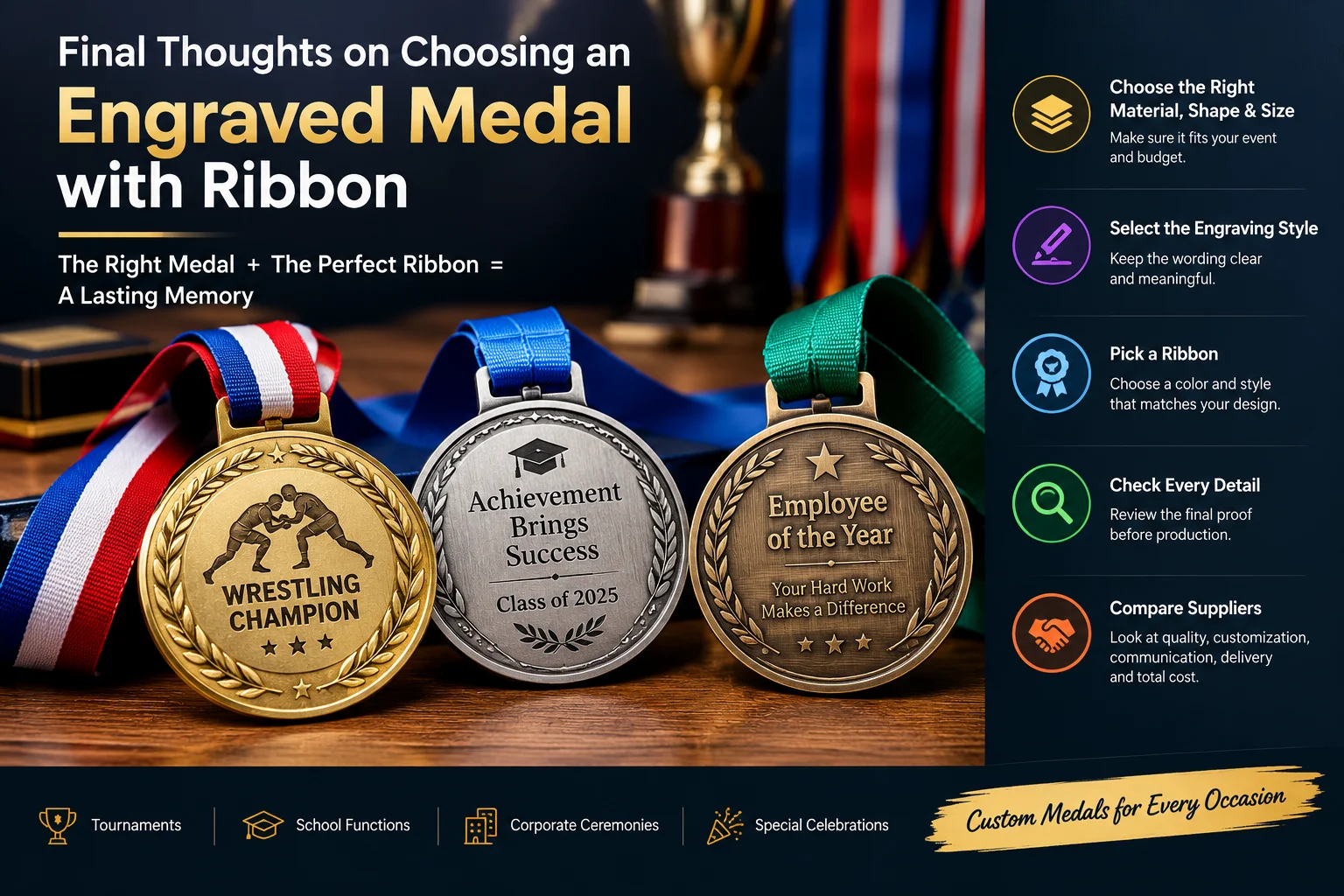
Choosing the right engraved medal with ribbon begins with understanding what the award needs to represent. Whether you are recognizing a wrestling champion, celebrating school achievements, rewarding employees, or commemorating a special event, thoughtful customization can turn a simple medal into a meaningful keepsake.
Start by selecting a suitable material, shape, size, and engraving style. Then choose a ribbon that complements the design and suits the way recipients will wear or display the award. Keep the wording clear, check every personalized detail, and review the final proof before approving production.
It is equally important to compare suppliers carefully. Look beyond the advertised price and consider workmanship, customization options, communication, delivery schedules, and the complete cost of your order.
With the right planning, an engraved medal and matching ribbon can provide a coordinated, attractive, and memorable way to recognize achievement.
If you are planning a tournament, school function, corporate ceremony, or special celebration, explore custom medal options that match your event’s requirements. Prepare your artwork, confirm your specifications, and choose a design that gives every recipient a lasting reminder of the occasion.