


Wrestling Belt Maker: How to Choose the Right Custom Belt Craftsman (2026 Guide)

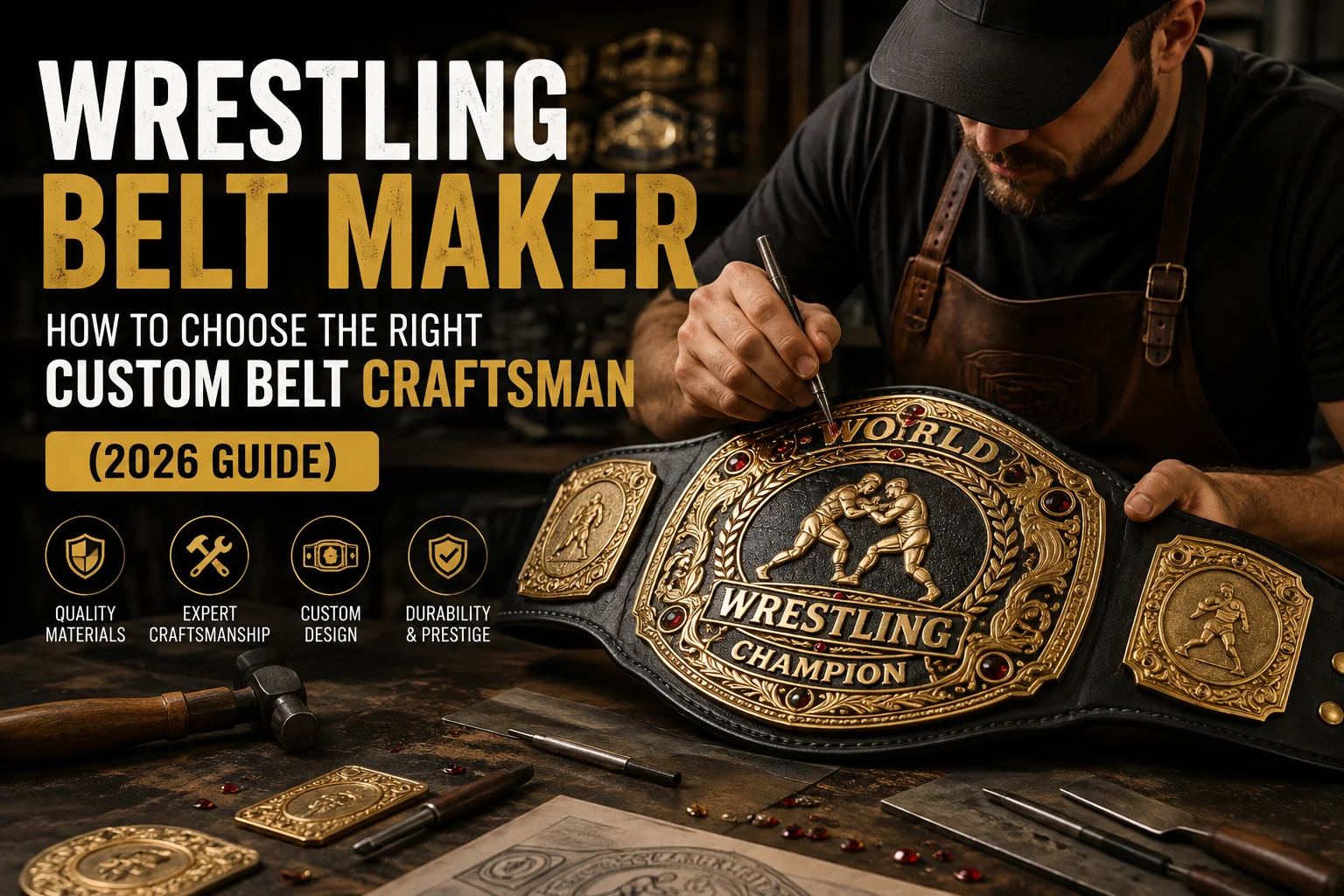
If you’ve ever held a real championship belt, you know the difference the second it’s in your hands. It has weight. The leather doesn’t feel like a cheap costume prop. The plates catch the light instead of looking like painted plastic. That feeling isn’t an accident — it’s the result of a wrestling belt maker who actually knows the craft, not someone who slapped a logo sticker on a mass-produced blank and shipped it out the door.
Whether you’re a wrestling promotion crowning your next champion, a gym owner rewarding your top athlete, a fantasy football commissioner settling an annual bet, or someone shopping for a one-of-a-kind gift, finding the right belt maker matters more than most people realize going in. A bad belt doesn’t just look bad — it cheapens the entire moment it’s supposed to celebrate. A great one becomes part of the story people tell for years.
This guide walks through everything you actually need to know before you hire a wrestling belt maker: what real craftsmanship looks like, what questions to ask, what things tend to go wrong, and how to tell a genuine shop from one that’s just reselling generic belts with a new label.
What Does a Wrestling Belt Maker Actually Do?
A wrestling belt maker designs and builds custom championship-style belts from scratch — or close to it. That includes:
- Designing the layout: center plate, side plates, strap style, and color scheme
- Sculpting or digitally modeling the artwork for each plate
- Casting the metal plates (usually in zinc alloy or similar metals)
- Plating the metal in gold, silver, bronze, or a custom finish
- Cutting and shaping the leather or synthetic strap
- Setting any gemstones, crystals, or inlays
- Assembling the final piece — mounting plates, attaching hardware, and finishing edges
Some makers do every one of these steps in-house. Others outsource parts of the process, like casting or leatherwork, to third-party suppliers and just handle design and assembly. Neither approach is automatically bad, but it’s worth knowing which one you’re dealing with, because it affects both price and quality control.
The best belt makers treat this like actual trophy-making, not novelty manufacturing. They understand that a belt has to survive being held overhead, worn during a match, photographed under bright lights, and passed around a locker room — not just sit nicely in a display case.
Why the Quality of a Belt Maker Actually Matters
It’s tempting to think a belt is a belt. It’s not. Here’s what separates a well-made belt from a disappointing one, and why the maker behind it makes all the difference.
The Strap Has to Actually Hold Up
Cheap belts often use thin, stiff synthetic straps that crack within months, especially if the belt gets worn regularly or stored folded. A skilled wrestling belt maker uses genuine or high-grade vegan leather that’s thick enough to support heavy metal plates without sagging or splitting at the rivet holes. The strap should flex naturally around the waist, not sit like a stiff board.
The Plates Should Have Real Depth
Look closely at a low-quality belt and you’ll often see flat, shallow etching — more like a sticker pressed into metal than an actual sculpted design. A good maker casts plates with real depth and dimension, so the artwork has shadow and texture even from a few feet away. This is one of the easiest ways to spot the difference between a real craftsman and a shortcut shop, even in photos.
Weight Signals Craftsmanship
This sounds obvious, but it trips a lot of buyers up. A championship belt is supposed to feel substantial when you lift it. If a belt feels almost weightless, it’s usually because the plates are made from thin, hollow-cast metal instead of a properly weighted alloy. Weight isn’t just about bragging rights — it’s a genuine indicator of how much metal actually went into the plates.
Finishing Determines How It Ages
Gold and silver finishes wear differently depending on how they’re applied. A rushed plating job flakes, tarnishes, or turns a dull brown within weeks of regular handling. A proper finish — applied correctly and sealed — holds its shine for years, even under stage lighting and regular use.
Types of Wrestling Belts a Good Maker Should Offer
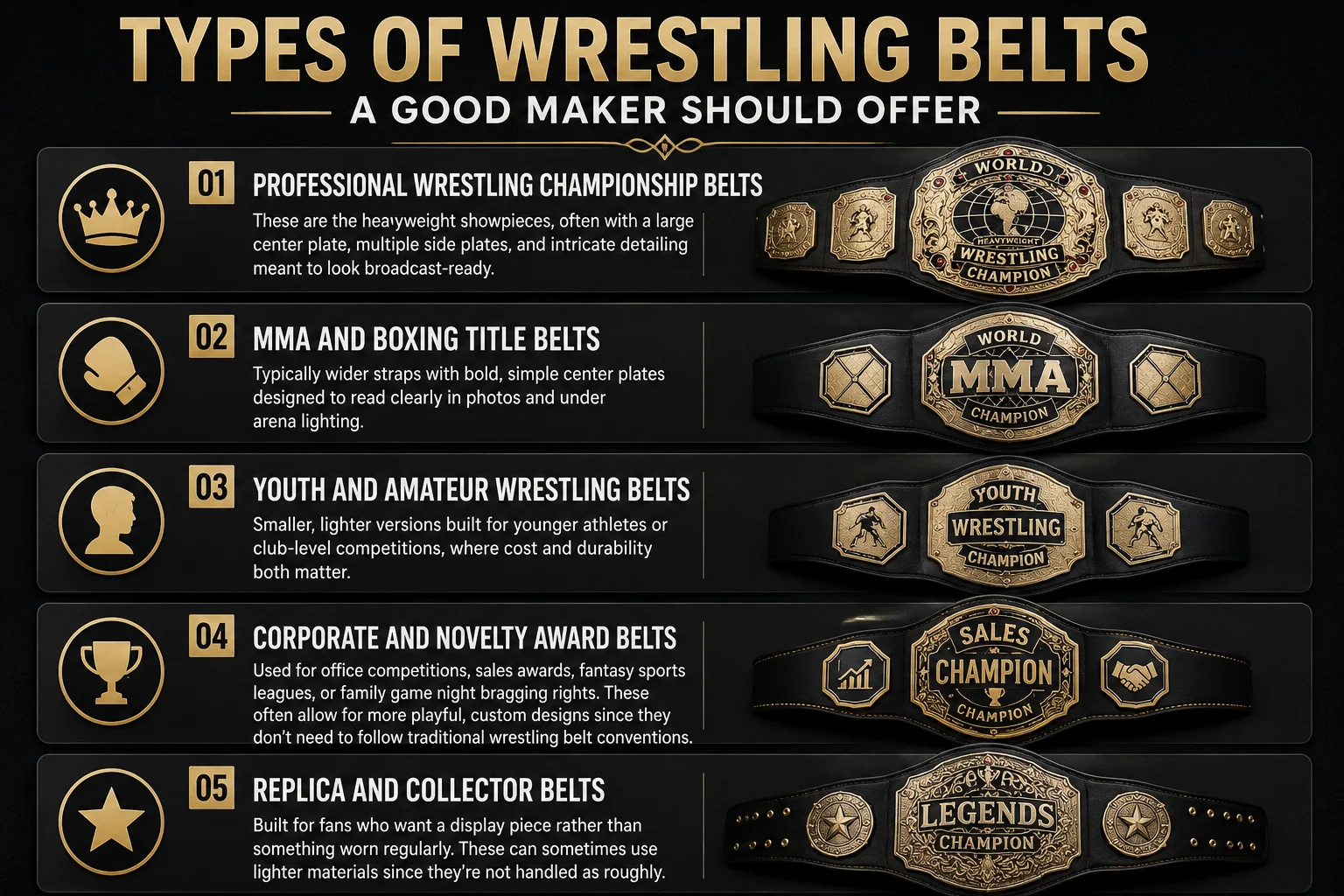
Not every belt maker builds every style well. Before you commit, check whether the shop actually specializes in the type of belt you need, rather than just offering a generic catalog.
Professional wrestling championship belts — These are the heavyweight showpieces, often with a large center plate, multiple side plates, and intricate detailing meant to look broadcast-ready.
MMA and boxing title belts — Typically wider straps with bold, simple center plates designed to read clearly in photos and under arena lighting.
Youth and amateur wrestling belts — Smaller, lighter versions built for younger athletes or club-level competitions, where cost and durability both matter.
Corporate and novelty award belts — Used for office competitions, sales awards, fantasy sports leagues, or family game night bragging rights. These often allow for more playful, custom designs since they don’t need to follow traditional wrestling belt conventions.
Replica and collector belts — Built for fans who want a display piece rather than something worn regularly. These can sometimes use lighter materials since they’re not handled as roughly.
A maker who’s genuinely experienced across these categories will usually be upfront about which one they specialize in, rather than claiming to be equally great at everything.
Custom Design: What You Should Be Able to Control
A real custom wrestling belt maker gives you meaningful control over the design, not just a name swap on a template. At minimum, you should be able to choose:
- Strap color and material (leather vs. synthetic)
- Number of plates (single center plate vs. center plus side plates)
- Metal finish (gold, silver, black nickel, antique bronze, etc.)
- Custom text, logos, or artwork on each plate
- Gemstone or crystal accents, if wanted
- Belt length, to properly fit the person wearing it
If a company can’t tell you clearly how belt length is measured or adjusted, that’s a red flag. A belt that doesn’t fit the wearer looks awkward in every photo, no matter how nice the plates are.
Questions to Ask Before You Hire a Wrestling Belt Maker
Before placing an order, especially for something expensive or time-sensitive like a title belt for an upcoming event, ask these questions directly:
- Do you make the belts yourselves, or resell from another manufacturer?
- What materials are used for the strap and plates?
- Can I see photos of a completed belt like the one I’m ordering — not just a digital mockup?
- What’s the realistic production timeline, including a buffer for revisions?
- Do you offer a proof or mockup approval step before production starts?
- What happens if a plate is damaged or the belt arrives with a defect?
- Can the belt be resized or repaired later if needed?
A maker with real experience won’t hesitate on any of these. Vague or evasive answers — especially around materials and production location — are usually a sign the company is a middleman rather than an actual manufacturer.
Getting these answers early saves you from the most common regret buyers have: ordering based on a polished website, only to receive something that doesn’t match the photos at all.
This is usually the first question people ask, and honestly, the answer varies a lot depending on what goes into the belt. Rather than throwing out a single number that won’t hold up across different makers and regions, it’s more useful to understand what actually drives the price up or down.
Number of plates — A single center plate belt costs less than one with a center plate plus two or four side plates. More plates means more casting, more metal, more assembly time.
Metal and plating quality — Thicker castings and higher-grade plating cost more than thin, quick-cast alternatives. This is usually where corners get cut on cheap belts, because it’s the least visible difference until the belt is in your hands.
Strap material — Genuine leather typically costs more than synthetic alternatives, but it also tends to last longer and age better.
Level of customization — A fully custom sculpted design with original artwork costs more than choosing from a maker’s existing plate templates and just swapping in your text or logo.
Extras — Gemstones, crystal accents, engraved nameplates, and display cases all add to the final price.
A reasonable approach is to get quotes from two or three makers for the exact same specs — same plate count, same materials, same finish — so you’re comparing apples to apples instead of comparing a stripped-down quote from one shop against a fully-loaded quote from another.
If a price seems dramatically lower than everyone else’s for what sounds like the same belt, that’s usually explained by thinner metal, synthetic materials marketed as premium, or a much smaller design than the photos suggest.
How Long Does It Take to Make a Custom Belt?
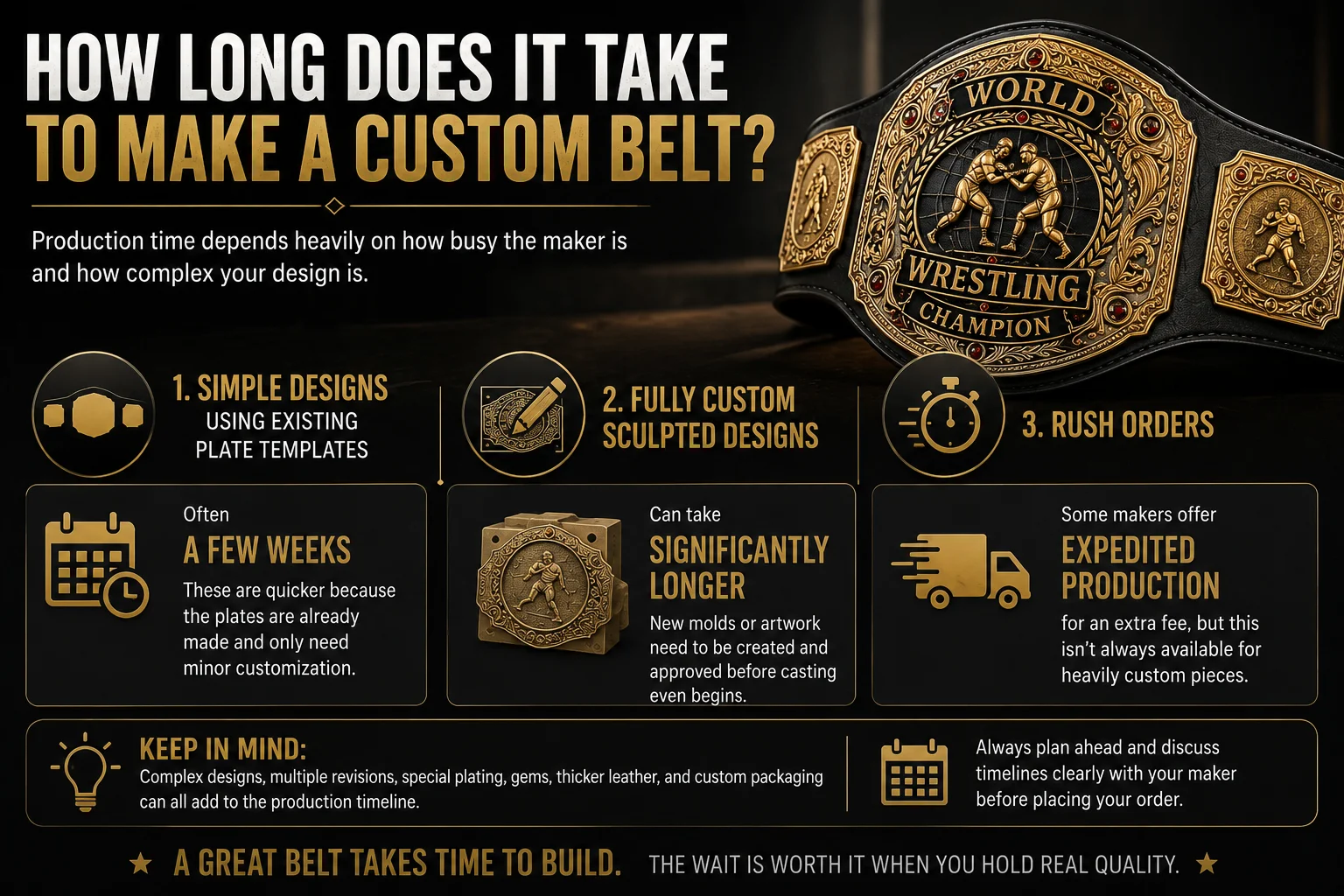
Production time depends heavily on how busy the maker is and how complex your design is. As a general guide:
- Simple designs using existing plate templates: often a few weeks
- Fully custom sculpted designs: can take significantly longer, since new molds or artwork need to be created and approved before casting even begins
- Rush orders: some makers offer expedited production for an extra fee, but this isn’t always available for heavily custom pieces
If you’re ordering a belt for a specific event — a title match, an awards night, a tournament final — build in extra time beyond whatever the maker quotes you. Shipping delays, revision rounds, and production backlogs are common, and a belt that arrives the day after the event is a belt that missed its entire purpose.
Ask for a firm timeline in writing, including how long the approval and revision process typically takes, not just the casting and assembly time.
Common Mistakes People Make When Ordering a Custom Belt
Skipping the mockup approval step. Some cheaper shops rush straight to production to save time. Always insist on approving a digital proof — and ideally photos of the actual cast plate — before the belt is fully assembled.
Not specifying belt length clearly. A belt that’s too long or too short changes how the whole thing sits and photographs. Measure properly and confirm with the maker how they size belts (waist measurement, adjustable holes, custom length, etc.).
Choosing based on renders alone. A polished 3D render can make almost any design look premium. Always ask for real photos of belts the maker has actually produced, ideally in a similar style to what you’re ordering.
Ignoring the return or defect policy. Custom items are often non-refundable once production starts, which makes it even more important to clarify upfront what happens if something arrives damaged or doesn’t match the approved design.
Assuming faster is always better. A maker that promises an unusually quick turnaround on a heavily custom, multi-plate belt may be cutting steps — like skipping proper curing time on plating, or using shortcuts in the leatherwork — to hit that deadline.
Signs You’re Working With a Genuine Craftsman
A few practical signals tend to separate serious wrestling belt makers from shops just reselling generic stock:
- They ask detailed questions about your design intent, not just your budget
- They can explain their materials and process without sounding scripted
- Their portfolio shows variety — different plate styles, strap colors, and belt types — not the same template with different logos
- They’re upfront about production time, including worst-case scenarios
- They offer some kind of proof or approval step before full production
- Their photos show belts being worn or held, not just staged on a flat surface under studio lighting
None of these individually guarantee a great experience, but a maker who checks most of these boxes is far more likely to deliver something you’ll actually be proud to hand over.
Caring for a Custom Wrestling Belt
Once you’ve got your belt, a little care goes a long way toward keeping it looking sharp for years:
- Store it flat or hung, not folded, to avoid stressing the leather at the crease
- Keep it away from direct sunlight and excess humidity, which can dull plating and dry out leather over time
- Wipe metal plates with a soft, dry cloth after events to remove sweat or handling residue
- Avoid harsh cleaning chemicals on plated metal, since they can strip the finish
- If the belt will be worn regularly rather than just displayed, ask the maker about touch-up or repair options in advance
A well-made belt from a skilled maker should hold up to years of use with basic care — that durability is really the whole point of paying for custom craftsmanship in the first place.
Frequently Asked Questions
Can a wrestling belt maker recreate a specific existing belt design?
Many can create belts inspired by a certain style or era, but reputable makers will avoid directly copying another company’s trademarked designs. It’s better to ask for something “inspired by” a look you like rather than an exact replica of a protected design.
Do I need to provide my own artwork?
Not necessarily. Many makers offer design help or existing templates you can customize. If you have a specific logo or artwork, most shops can incorporate it, but be prepared for revision rounds to get proportions and placement right on a curved metal plate.
Are custom belts adjustable for different waist sizes?
Most straps have multiple hole settings for adjustment, but if the belt needs to fit a significantly different size later, ask the maker whether resizing is possible after the fact.
What’s the difference between a “display” belt and a “wearable” belt?
Display belts are sometimes built lighter since they’re not meant to be worn or handled often. Wearable belts need sturdier straps and more secure plate mounting to hold up to regular use. Always tell your maker which one you actually need.
Final Thoughts
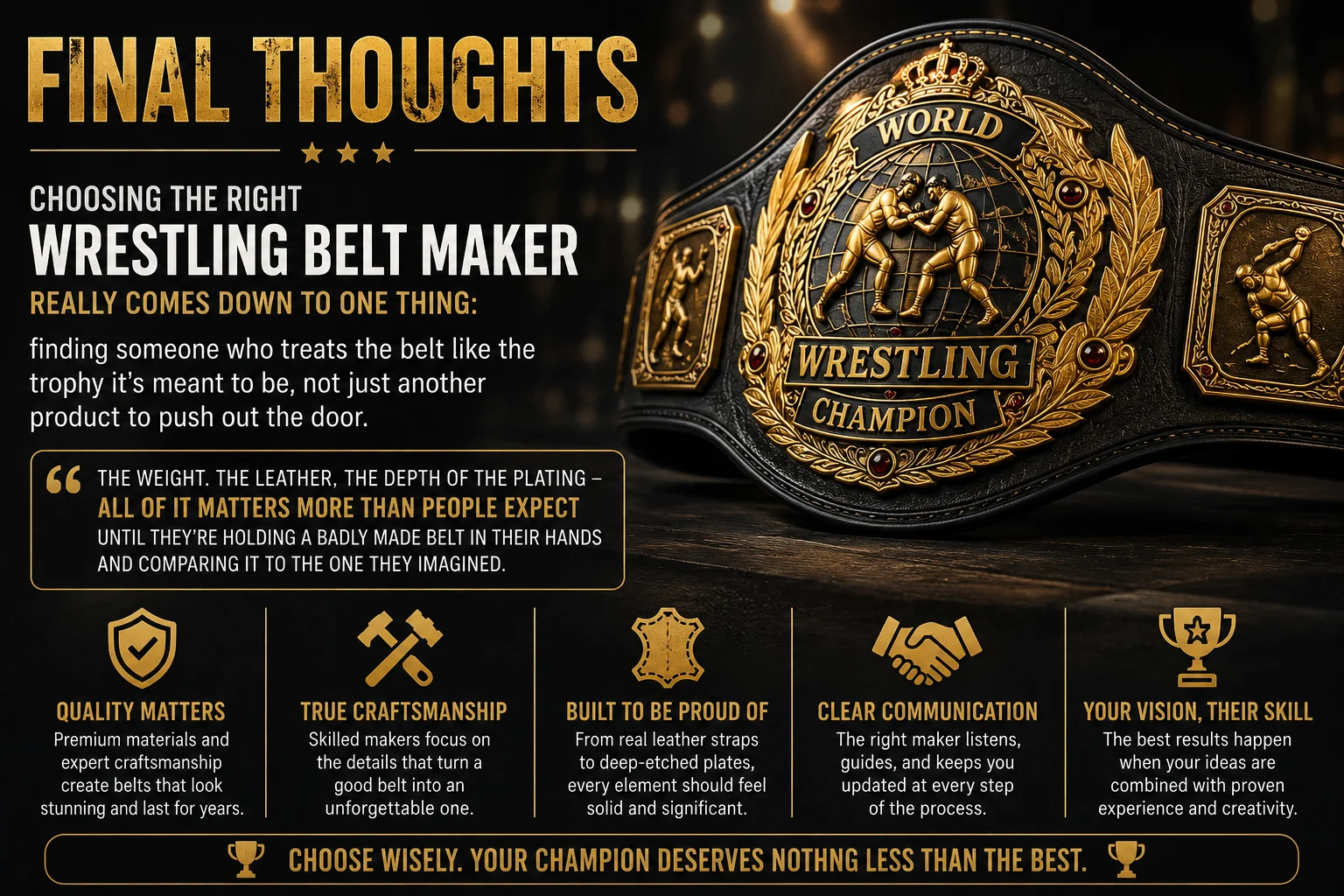
Choosing the right wrestling belt maker really comes down to one thing: finding someone who treats the belt like the trophy it’s meant to be, not just another product to push out the door. The weight, the leather, the depth of the plating — all of it matters more than people expect until they’re holding a badly made belt in their hands and comparing it to the one they imagined.
Take the time to ask real questions, request real photos, and compare quotes on equal terms. A little extra research before you order is what stands between handing your winner something they’ll actually be proud to lift over their head, and handing them something that ends up in a closet within a year.