
Pendant Materials Guide: Materials for WWE & Wrestling Pendants

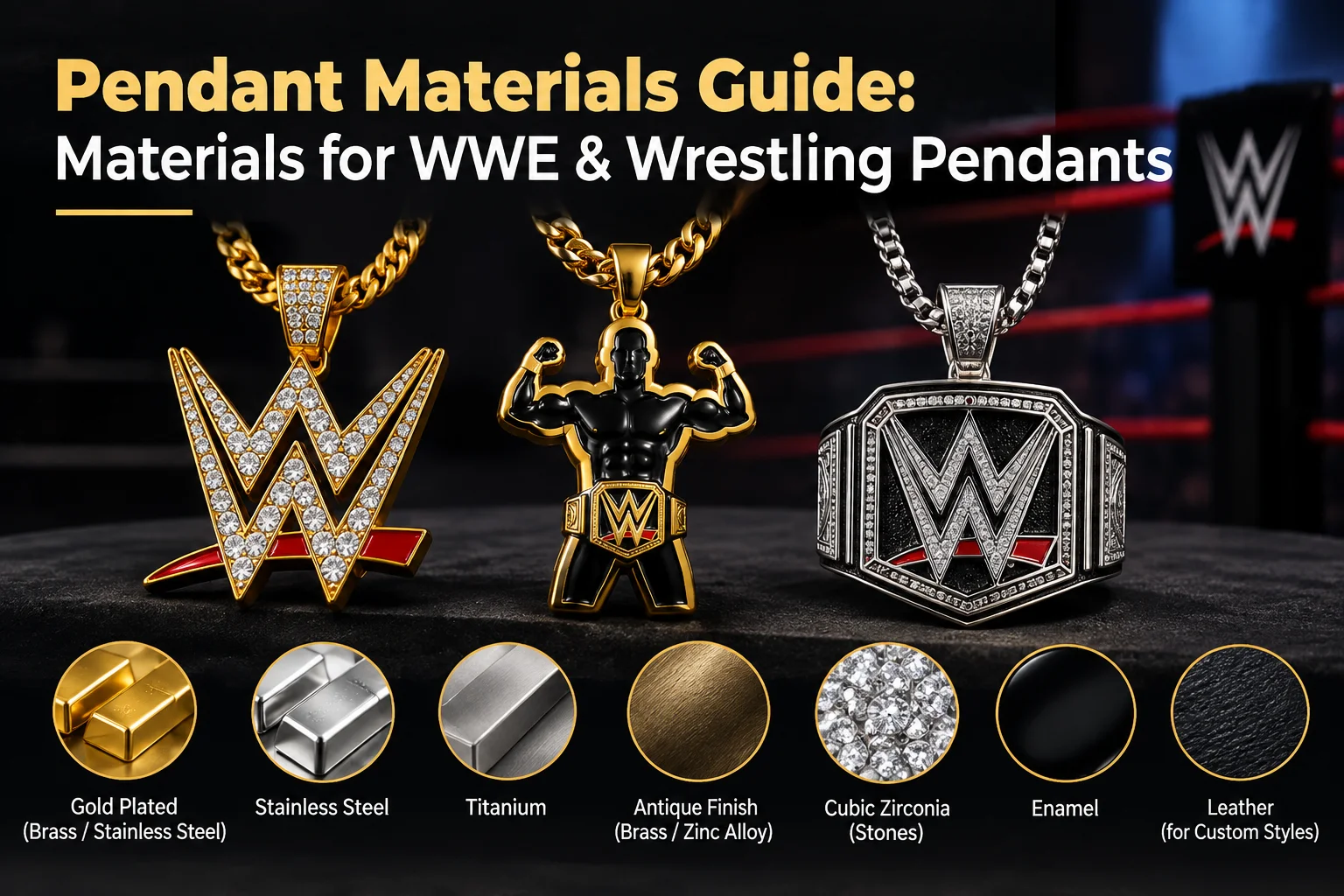
A great wrestling pendant is more than a piece of jewelry. For WWE fans, collectors, athletes, and custom jewelry enthusiasts, a pendant can represent a favorite wrestler, championship era, wrestling faction, nickname, logo, or memorable moment.
But before choosing a design, one important question is often overlooked: what should the pendant be made from?
The material affects almost everything about a pendant, including its weight, strength, appearance, surface finish, stone setting, comfort, and long-term durability. Two pendants can have almost identical designs but feel completely different when worn because they are made from different materials.
This Pendant Materials Guide explains the most common materials used for wrestling and WWE-style pendants and what you should know before choosing one.
Whether you want a bold spinner pendant, a logo pendant, a championship-inspired design, or a completely custom piece, understanding the material helps you make a more informed choice.
Why Pendant Material Matters
The design may be the first thing you notice, but the material determines how that design performs in everyday use.
A pendant needs enough strength to support its shape while remaining comfortable around the neck. It also needs a surface that can accept the desired finish, engraving, plating, stones, or other decorative details.
For example, a large wrestling pendant with multiple raised elements and stones may need a material that can provide enough structural support without making the piece unnecessarily heavy.
Material can influence:
- Pendant weight
- Strength and durability
- Surface appearance
- Polishing quality
- Plating options
- Stone-setting possibilities
- Resistance to everyday wear
- Overall feel
- Maintenance requirements
- Production cost
That is why choosing a pendant material should happen at the beginning of the design process rather than after the artwork has already been finalized.
Common Materials Used for Wrestling Pendants
There is no single material that is perfect for every pendant. The right choice depends on the design, intended use, size, finish, and personal preference.
Some of the most common options include:
- Zinc alloy
- Stainless steel
- Brass
- Sterling silver
- Gold and gold-plated materials
- Other plated metal combinations
Let’s look at each option more closely.
1. Zinc Alloy Pendants
Zinc alloy is one of the practical choices for creating detailed custom pendants.
It is particularly useful when a design includes intricate shapes, raised lettering, logos, borders, cutouts, or multiple decorative sections.
For WWE-style jewelry, this can be especially useful because wrestling-inspired designs often feature bold logos and layered details.
Zinc alloy can also provide a substantial feel without requiring the pendant to be made entirely from a precious metal.
Why Zinc Alloy Works for Custom Pendants
One advantage is design flexibility. Manufacturers can use suitable zinc alloys for cast or molded designs with detailed shapes.
This makes the material suitable for designs such as:
- Wrestling logos
- Spinner pendants
- Initial pendants
- Custom name plates
- Championship-inspired symbols
- Large statement pendants
- Intricate geometric designs
The finished piece can then receive different surface treatments or plating to create a gold, silver, black, or other visual appearance.
What to Consider
Zinc alloy is not the same thing as solid gold or sterling silver. Buyers should understand what the base metal actually is rather than judging quality only by the surface finish.
If a pendant has a premium-looking gold or silver appearance, check whether that appearance comes from plating or from the underlying metal itself.
That distinction becomes especially important when comparing different custom jewelry options.
2. Stainless Steel Pendants
Stainless steel is another popular option for modern pendants, especially when durability is a major concern.
It has a clean metallic appearance and works well with contemporary jewelry designs.
For wrestling fans, stainless steel can be used for everything from simple logo pendants to heavier statement pieces.
One of its biggest advantages is its reputation as a practical everyday material. It is generally strong and suitable for jewelry that is expected to receive regular use.
Stainless Steel for Wrestling Jewelry
A stainless steel pendant can work particularly well when you want a design that feels:
- Modern
- Clean
- Strong
- Minimal
- Masculine
- Suitable for everyday wear
It can also be finished in different ways to change its appearance. Polished surfaces can create a bright reflective look, while brushed or darker finishes can produce a more understated style.
Stainless Steel vs. Zinc Alloy
The choice between stainless steel and zinc alloy depends largely on the design and intended use.
Zinc alloy can be useful for complex decorative shapes and cast designs, while stainless steel is often selected when a straightforward, durable metal construction is desired.
Neither should automatically be considered the right choice for every pendant.
The design itself matters just as much as the base material.
3. Brass Pendants
Brass is another metal that can be used for decorative jewelry and custom pendants.
It has a naturally warm, yellowish metallic appearance and can work particularly well for vintage, traditional, or antique-inspired designs.
For wrestling jewelry, brass can provide an interesting foundation for designs that are intended to look old-school or heavily detailed.
Why Choose Brass?
Brass can be attractive when the goal is a classic metal appearance rather than a highly modern finish.
It can also be finished or plated depending on the desired look.
A brass-based pendant may work well for:
- Vintage wrestling designs
- Retro logos
- Classic-style lettering
- Antique finishes
- Detailed decorative pendants
However, the final appearance depends heavily on the finish applied to the metal and how the piece is maintained.
4. Sterling Silver Pendants
For buyers looking for a precious-metal option, sterling silver is an important material to consider.
Sterling silver is commonly used in jewelry because it offers the appearance and characteristics associated with precious-metal jewelry while being more accessible than solid gold.
A silver wrestling pendant can give a custom design a more traditional jewelry feel.
It is especially suitable for someone who wants the pendant itself to be made from a precious-metal alloy rather than simply receiving a silver-colored finish.
What Makes Silver Different?
The biggest distinction is between silver-colored plating and actual sterling silver.
A pendant made from another base metal and coated with a silver-colored finish is not the same as a sterling silver pendant.
If the material matters to you, ask the manufacturer exactly what the base metal is and whether the finish is plating or the actual material.
Sterling silver can also develop tarnish over time, so proper care and storage are important.
5. Gold and Gold-Plated Pendants
Gold is one of the most recognizable luxury finishes in jewelry.
For wrestling pendants, a gold appearance can create a bold, championship-inspired aesthetic. This is particularly effective when the design features large lettering, logos, stones, or a raised center.
However, it is important to distinguish between solid gold, gold alloy, and gold plating.
These are not interchangeable terms.
Solid Gold
Solid gold jewelry is made from a gold alloy throughout the main metal structure rather than simply having a gold-colored surface.
Different karats represent different proportions of gold and other metals.
Because of its material value and characteristics, solid gold is generally treated as a premium jewelry option.
Gold Plating
Gold plating involves applying a layer of gold over another base material.
This allows manufacturers to create a gold appearance without making the entire pendant from solid gold.
For statement wrestling jewelry, gold plating can be used to create the visual impact of a gold-colored pendant while allowing the underlying piece to be constructed from another suitable metal.
The important thing is to know exactly what you are buying.
Material vs. Finish: What’s the Difference?
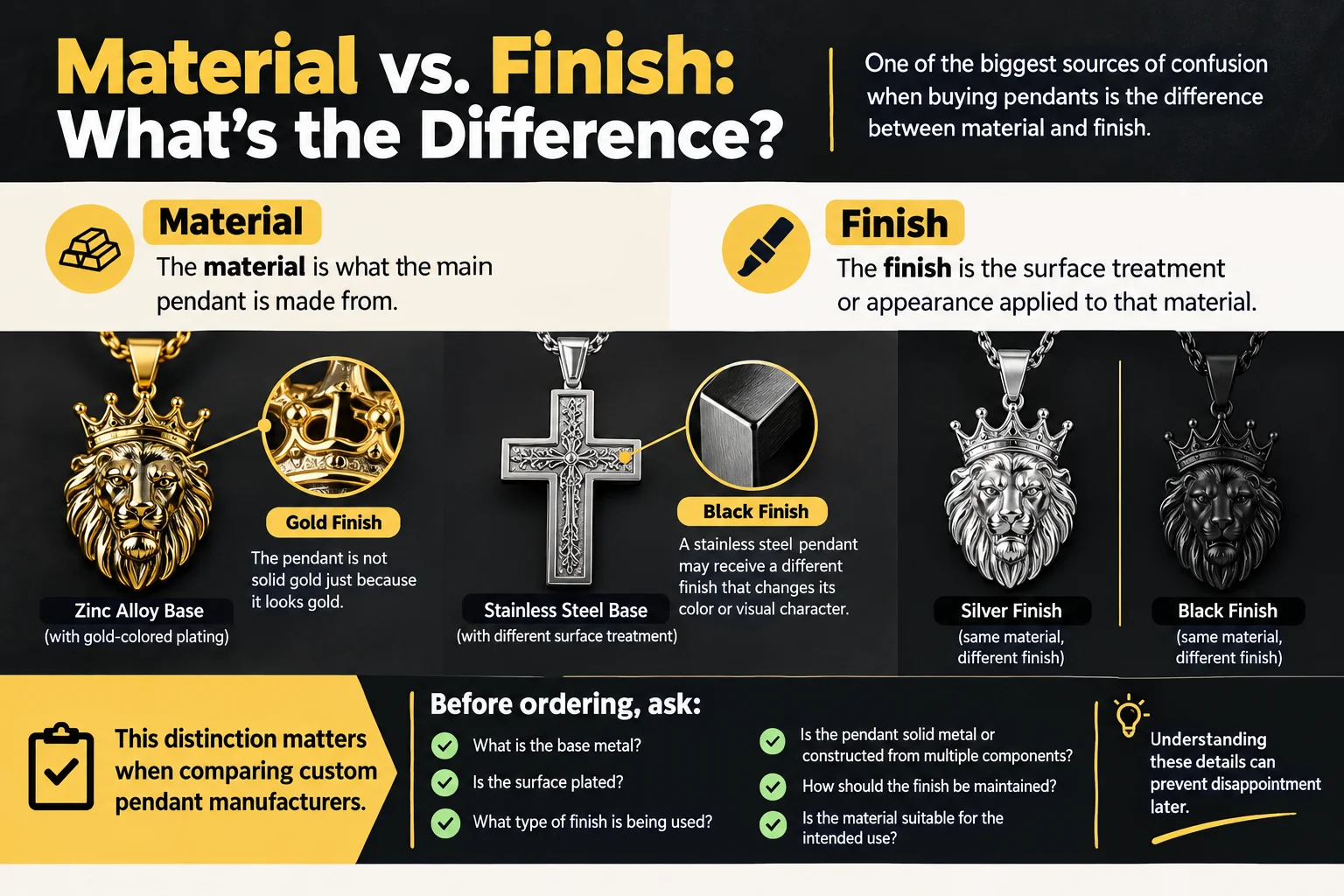
One of the biggest sources of confusion when buying pendants is the difference between material and finish.
The material is what the main pendant is made from.
The finish is the surface treatment or appearance applied to that material.
For example, a pendant could have a zinc alloy base with a gold-colored plating. In that case, the pendant is not solid gold simply because it looks gold.
Similarly, a stainless steel pendant may receive a different surface treatment that changes its color or visual character.
This distinction matters when comparing custom pendant manufacturers.
Before ordering, ask:
- What is the base metal?
- Is the surface plated?
- What type of finish is being used?
- Is the pendant solid metal or constructed from multiple components?
- How should the finish be maintained?
- Is the material suitable for the intended use?
Understanding these details can prevent disappointment later.
How Pendant Material Affects Weight
Weight is particularly important for large wrestling pendants.
A small logo pendant and a large championship-style pendant do not necessarily need the same material or construction approach.
The final weight depends on several factors, including:
- Overall dimensions
- Thickness
- Metal density
- Hollow or solid construction
- Number of components
- Stone settings
- Spinner mechanisms
- Bail design
A large pendant made from a dense material can become uncomfortable if it is too heavy for the chain being used.
On the other hand, a lightweight pendant may not provide the substantial feel some collectors expect from a wrestling-inspired statement piece.
The goal is to match the material and construction to the size of the design.
Choosing Material for a Spinner Pendant
Spinner pendants introduce another consideration because the design includes a moving component.
A spinner pendant typically contains a central section designed to rotate independently from the surrounding structure.
That means material selection should be considered alongside:
- Overall pendant size
- Centerpiece weight
- Moving-part construction
- Rotation mechanism
- Connection points
- Chain compatibility
For a wrestling-inspired spinner pendant, the visual effect is only part of the design. The moving center should also be properly balanced so that the pendant remains practical to wear.
This is one reason a detailed design discussion with the manufacturer is useful before production.
How Stones Change the Pendant Design
Many WWE-style and wrestling-inspired pendants use stones to create additional shine and visual depth.
Cubic zirconia and other decorative stones can be arranged around logos, lettering, borders, or spinner centers.
However, adding stones also affects the construction of the pendant.
A design should provide enough space for the stones and their settings without making the artwork look overcrowded.
The metal underneath needs to support those details while maintaining the intended shape.
For a bold wrestling pendant, the best result usually comes from balancing metalwork, lettering, stones, and negative space rather than trying to fill every available area.
Choosing the Right Material Starts With the Design
The best pendant material isn’t simply the most expensive one.
It is the material that works with the size, design, finish, intended use, and overall look you want.
For a simple everyday pendant, stainless steel may make sense. For an intricate custom wrestling design, zinc alloy may provide useful design flexibility. For someone specifically looking for precious-metal jewelry, sterling silver or gold may be more appropriate.
The important thing is to understand what is underneath the finish and how that material supports the design.
How to Choose the Right Pendant Material for a WWE-Inspired Design
Choosing the material becomes easier when you start with the purpose of the pendant rather than the metal itself.
A pendant designed as an everyday accessory may need different characteristics from a large collector’s piece or a detailed wrestling-inspired statement pendant.
Before placing an order, think about how you want the pendant to look, feel, and function.
Ask yourself:
- Will I wear it every day or occasionally?
- Do I want a lightweight or substantial pendant?
- Does the design contain stones or moving parts?
- Do I want a gold, silver, black, or natural metal appearance?
- Is the pendant mainly for fashion, collecting, or a special occasion?
- Will I use a large chain with it?
- Does the design require detailed engraving or raised elements?
Answering these questions can narrow down the material options considerably.
Everyday WWE-Style Pendants
For everyday wear, practicality is usually important.
A pendant worn frequently may experience contact with clothing, skin, chains, bags, and other objects. A practical metal such as stainless steel can be suitable for someone who wants a straightforward, durable jewelry piece.
A plated zinc alloy pendant can also work well when the main priority is a highly detailed custom design.
The key is to understand the expected wear and choose a finish that matches it.
If the pendant will be worn regularly, ask the manufacturer how the particular finish should be cleaned and maintained.
Large Wrestling Statement Pendants
Large pendants require more attention to weight and proportions.
A dramatic WWE-inspired pendant may include a large logo, multiple borders, stones, raised lettering, and a substantial bail for the chain.
Making everything larger isn’t always better.
If the pendant becomes excessively heavy, it can be uncomfortable around the neck. The chain also needs to be appropriate for the pendant’s size and weight.
A good design balances:
Pendant size + thickness + material + chain + wearing comfort
This is especially important when designing a custom championship-style pendant.
Pendant Materials for Custom Logos and Wrestling Symbols
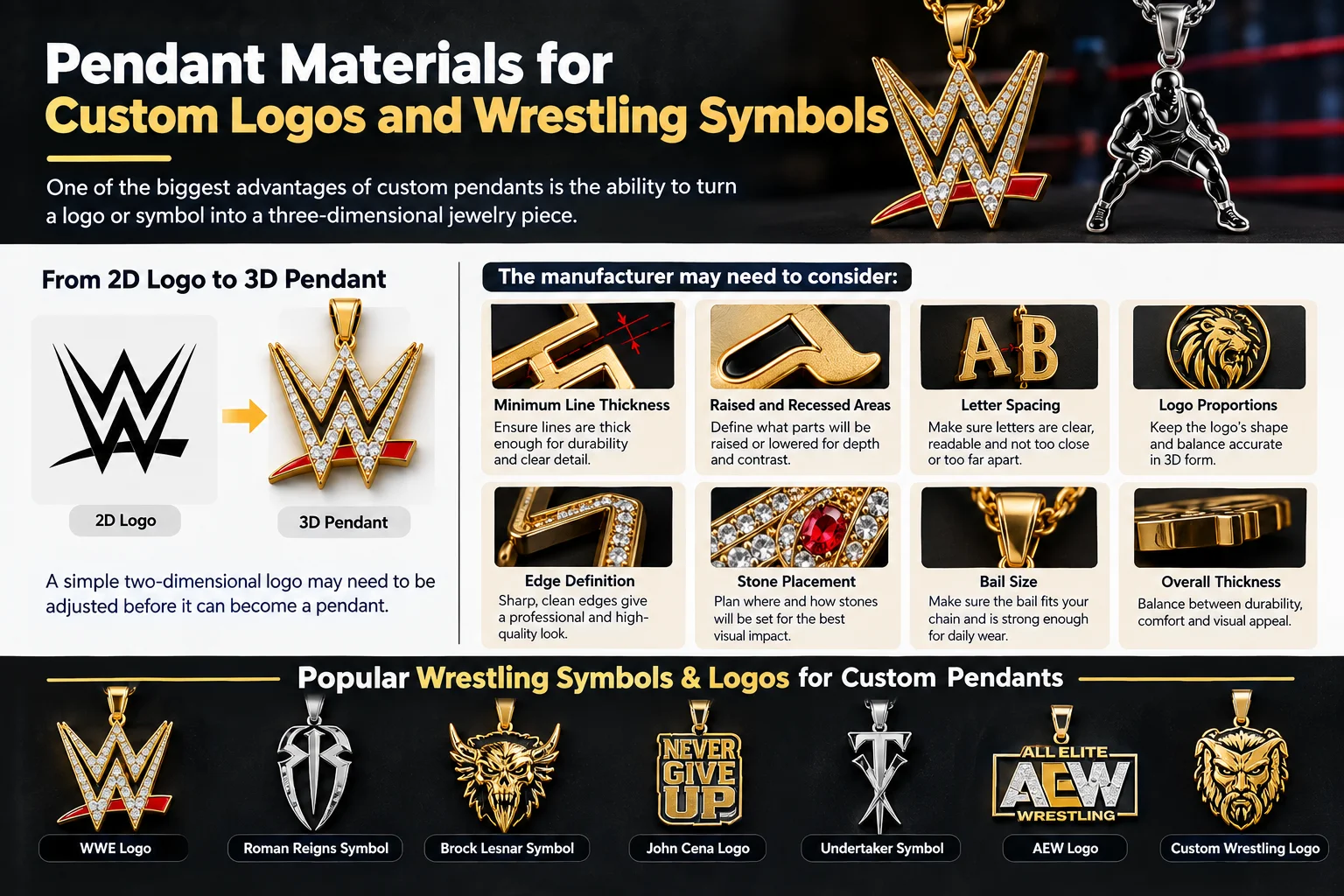
One of the biggest advantages of custom pendants is the ability to turn a logo or symbol into a three-dimensional jewelry piece.
A simple two-dimensional logo may need to be adjusted before it can become a pendant.
The manufacturer may need to consider:
- Minimum line thickness
- Raised and recessed areas
- Letter spacing
- Logo proportions
- Edge definition
- Stone placement
- Bail size
- Overall thickness
This is where the material and manufacturing method work together.
A material suitable for detailed casting can help reproduce complex shapes, while other materials may be better suited to simpler designs.
If you’re using a wrestling logo, initials, nickname, championship emblem, or original artwork, provide a high-quality design file whenever possible.
A clear reference makes it easier to determine what can realistically be reproduced.
Gold, Silver, Black, or Two-Tone Finish?
The material is only one part of the final appearance.
The finish can completely change how a wrestling pendant looks.
Gold Finish
Gold-colored finishes create a bold, championship-inspired appearance.
They work especially well with:
- Black details
- Clear stones
- Red accents
- Raised lettering
- Large center logos
Silver Finish
Silver-colored finishes provide a cleaner and more traditional jewelry appearance.
They can work well with monochrome designs, clear stones, blue accents, and detailed engraving.
Black Finish
Blackened or dark finishes can give a pendant a more aggressive, modern appearance.
They are often useful when the design includes strong contrast between the base metal and raised elements.
Two-Tone Finish
A two-tone pendant combines two contrasting finishes.
For example, the background could be darker while the raised logo remains bright. This creates visual depth without requiring additional graphics.
For wrestling-inspired designs, two-tone finishes can make lettering and logos easier to see.
How Chain Choice Relates to Pendant Material
A pendant and chain should be treated as one complete design.
A large statement pendant hanging from a very thin chain may look unbalanced. Likewise, a small pendant paired with an extremely large chain can overwhelm the design.
The chain should support the pendant visually and physically.
Consider:
- Pendant dimensions
- Pendant weight
- Bail size
- Chain thickness
- Chain style
- Desired wearing position
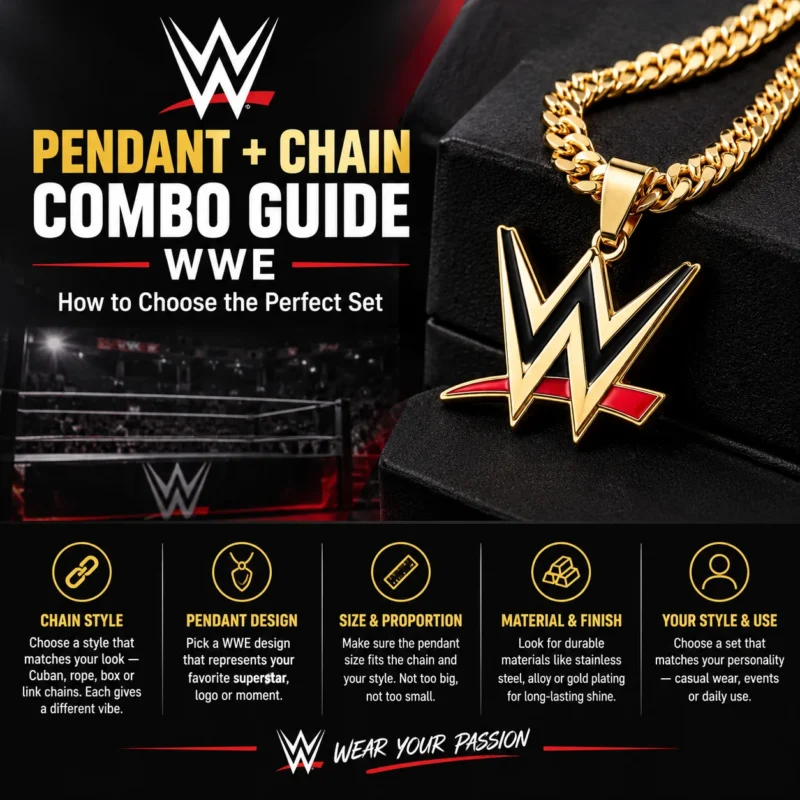
Popular chain styles can include Cuban, Franco, rope, box, and other designs.
A heavier pendant generally requires more attention to the strength and compatibility of the chain and bail.
Pendant Thickness Matters Too
Two pendants can have the same height and width but feel completely different because their thicknesses are different.
Thickness affects:
- Weight
- Depth
- Durability
- 3D appearance
- Raised details
- Overall feel
A very thin pendant may work beautifully for a simple logo.
A complex wrestling pendant with multiple raised layers may benefit from greater depth.
However, increasing thickness simply to make a pendant feel more substantial can also increase its weight.
This is why thickness should be decided alongside the material and dimensions.
How to Care for Different Pendant Materials
Even a well-made pendant needs proper care.
The exact cleaning method depends on the metal and finish, so always follow the manufacturer’s recommendations.
In general, it is sensible to avoid unnecessary exposure to:
- Harsh chemicals
- Perfume
- Cleaning products
- Chlorinated water
- Excessive moisture
- Abrasive materials
After wearing a pendant, gently wiping it with an appropriate soft cloth can help remove surface oils and residue.
Store jewelry separately when possible. This helps reduce scratches caused by contact with other metal pieces.
Extra Care for Plated Pendants
Plated pendants require particular attention because the visible finish is a surface layer.
Repeated friction, chemicals, moisture, and rough handling can gradually affect the appearance of a plated surface.
That doesn’t mean plated jewelry cannot be worn regularly. It simply means the wearer should understand that the finish may require more care than a pendant made from the same material throughout.
What to Ask a Custom Pendant Manufacturer
If you’re ordering a custom WWE-inspired pendant, don’t rely only on product photos.
Ask specific questions about construction.
A useful checklist includes:
1. What is the base material?
Find out whether it is zinc alloy, stainless steel, brass, sterling silver, gold, or another material.
2. Is the pendant plated?
If it has a gold, silver, black, or other finish, ask whether it is plating or the natural surface of the metal.
3. What are the exact dimensions?
Ask for height, width, and thickness.
4. What is the approximate weight?
This is especially important for large pendants.
5. How are the stones installed?
If the pendant contains stones, ask about their setting and arrangement.
6. Is the center fixed or movable?
This matters for spinner pendants.
7. What chain size is recommended?
The bail and pendant weight should work with the selected chain.
8. Can I approve the design before production?
A digital mockup or production preview can help identify problems before manufacturing begins.
These questions can save time and prevent misunderstandings.
Common Pendant Material Mistakes to Avoid
Choosing a pendant based only on its appearance is one of the most common mistakes.
A product can look impressive in a photograph while the buyer still doesn’t know what metal is underneath the finish.
Here are some other mistakes worth avoiding.
Choosing by Color Alone
A gold-looking pendant isn’t necessarily made from gold.
A silver-looking pendant isn’t necessarily sterling silver.
Always separate appearance from material.
Ignoring Weight
Large pendants can become surprisingly heavy.
Check the approximate weight before choosing an oversized design, especially if you plan to wear it for several hours.
Using a Weak Chain
A substantial pendant needs a chain and connection point that are appropriate for its size.
The chain shouldn’t be selected as an afterthought.
Overloading the Design
Adding more stones, lettering, logos, and decorative elements doesn’t automatically improve a wrestling pendant.
A strong design usually has a clear focal point.
Not Checking the Back
The front gets most of the attention, but the back also matters.
Check whether the back is:
- Flat or detailed
- Hollow or solid
- Engraved
- Smooth
- Designed with a specific closure or bail
For custom jewelry, these details can affect comfort and durability.
Material Guide: Which Option Fits Your Pendant?
There isn’t one universal answer because different materials serve different purposes.
| Material | Common Strength | Suitable For |
|---|---|---|
| Zinc Alloy | Detailed custom shapes | Wrestling logos, statement pendants, spinner designs |
| Stainless Steel | Practical and durable construction | Everyday pendants and modern designs |
| Brass | Warm traditional appearance | Vintage and decorative designs |
| Sterling Silver | Precious-metal jewelry | Premium custom pendants |
| Gold | Precious-metal luxury | High-end jewelry and special pieces |
| Gold Plating | Gold-colored appearance over another metal | Statement and fashion pendants |
This table is a starting point rather than a strict rule.
The final choice should also consider the pendant’s dimensions, construction, finish, intended use, and budget.
Custom WWE Pendant Design: Material Is Only the Beginning
A successful wrestling pendant is the result of several elements working together.
The material provides the foundation, but the design determines how that foundation is used.
For example, a custom pendant might combine:
- A zinc alloy body
- A polished gold-colored finish
- Raised lettering
- Clear cubic zirconia stones
- A rotating center
- A large bail
- A compatible Cuban-style chain
Another design might use stainless steel with a simple engraved logo and no stones.
Both can create completely different visual results.
The best approach is to decide on the overall concept first and then choose the material and construction method that support it.
Final Thoughts on Pendant Materials Guide
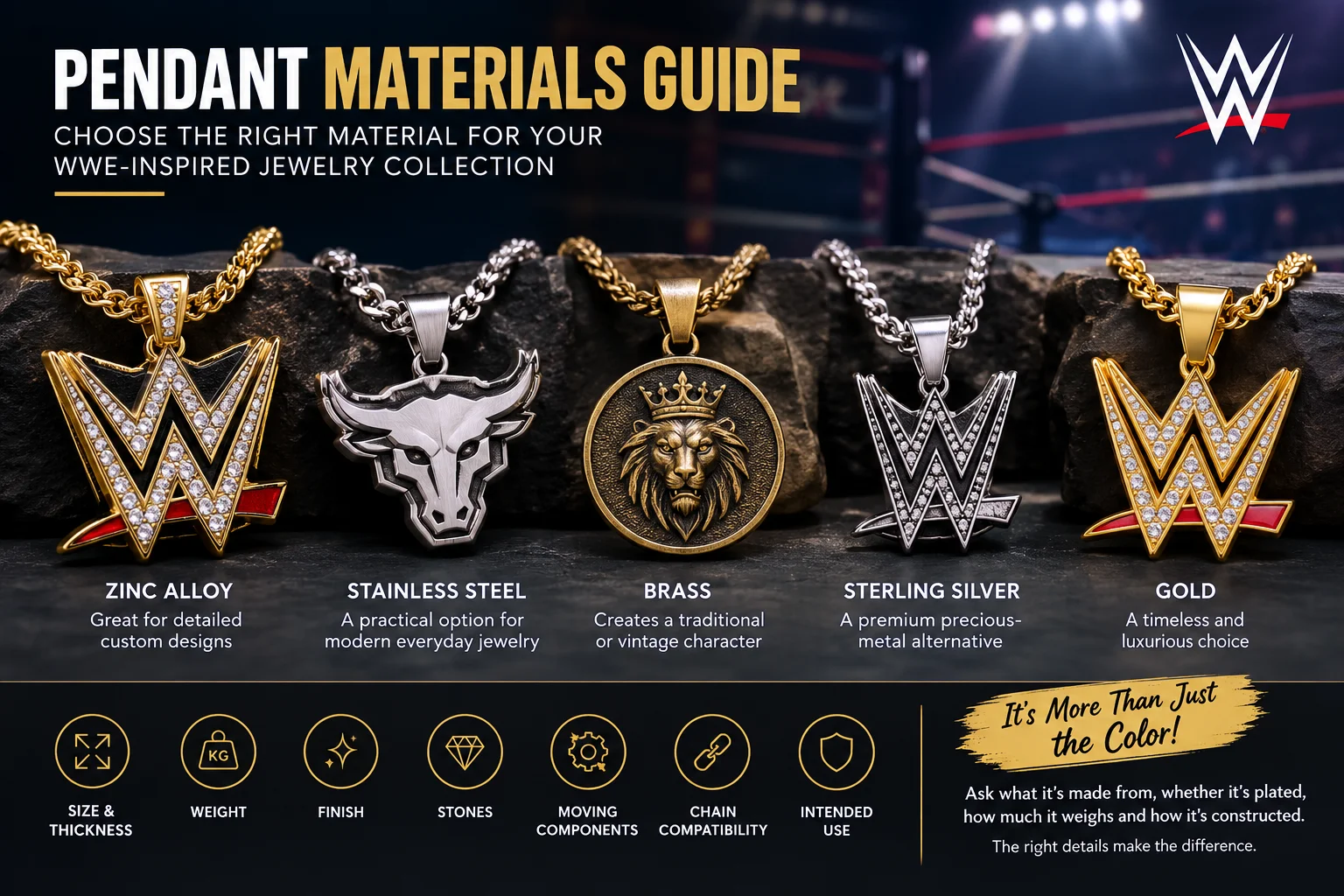
Understanding pendant materials makes it much easier to choose the right piece for a WWE-inspired jewelry collection.
Zinc alloy can be useful for detailed custom designs, while stainless steel offers a practical option for modern everyday jewelry. Brass can create a traditional or vintage character, while sterling silver and gold provide precious-metal alternatives.
But the base material is only one part of the decision.
You should also consider the pendant’s size, thickness, weight, finish, stones, moving components, chain compatibility, and intended use.
Most importantly, don’t judge a pendant only by its color or photograph. Ask what it is actually made from, whether the surface is plated, how much it weighs, and how the piece is constructed.
For a custom wrestling or WWE-inspired pendant, these details can make the difference between a design that simply looks good and one that feels like a properly finished piece of jewelry.
A well-planned pendant brings the design, material, finish, proportions, and construction together into one cohesive piece—and that’s what gives a wrestling-inspired pendant its distinctive character.